How Do You Know if a Light Bulb Is Halogen
The low-cal bulb market has gone through enormous changes since traditional incandescent bulbs were removed from the market and replaced with energy-saving bulbs. If you lot are undecided as to what type of lamp to choose, go on reading! Nosotros're hither to help yous choose the right light bulb based on your needs. One time you've narrowed down your pick of size, type, and effulgence, use our handy seedling finder to find your ideal light bulb from our wide option.
Let's get started.
i. Decide what fitting or cap type yous need
This is the near critical piece of information when selecting new bulbs – if you choose the wrong plumbing equipment or cap, your light bulb but won't fit. Despite that, choosing a calorie-free bulb with the wrong fitting or cap type is ane of the well-nigh mutual and frustrating mistakes made when purchasing lite bulbs.
Caps and bases are labelled using both letters and numbers. The letter indicates the type of base, while the number indicates the bore of the base in millimetres (mm). At that place may also exist a tertiary letter to indicate whether there are one, two, or iii pins.
Here are some of the most common cap and base types:
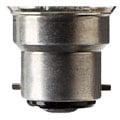
Bayonet
Bayonet bases are the most mutual base of operations type in the UK. These bulbs are placed into a socket using a push and twist action, and are primarily used in incandescent and CFL bulbs.
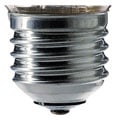
Spiral
Screw bases are also known equally "Edison" bases, which is why they are labelled using the letter "E". These bases are bachelor in a number of sizes.
In bulbs with spiral bases, two wires connect the filament to the base of operations, where electric voltage connects with and powers the bulb.
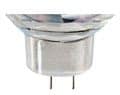
Pins or Pegs
These bases feature 2 narrow pins or pegs.
The distance between the pins or pegs is measured in millimetres and is indicated in the base of operations blazon code.
If y'all aren't certain what fitting or cap blazon you need, check out our caps and bases guide. Don't panic if yous don't run across the size you need – several cap types come in dissimilar sizes. If yous are in whatsoever dubiety, delight call our knowledgeable friendly customer service team on 01869 362222 who will be happy to aid. Our bulb finder is likewise a very useful tool to cheque.
2. Decide if you want CFL, halogen, or LED
In that location are three master types of regular light bulbs: CFLs, halogens, or LEDs. For a detailed explanation of each of these bulbs and their pros and cons, read our private guides and reviews of halogens, CFLs and LEDs.
Hither is a summary of each type of bulb, including how much a typical 700+ lumen bulb might cost you per year if you have it on for around three hours a mean solar day.
CFL (Compact Fluorescent Lamp)
Annual running cost: £2.04
CFLs are inexpensive and widely bachelor in a range of sizes and outputs. Some older CFLs were slow to brighten, just this has improved considerably in contempo years. They are four times more than efficient than incandescent bulbs and chop-chop pay for themselves in free energy savings, but not everyone likes the lite they emit.
READ CFL GUIDE FOR MORE Information
HALOGEN
Light from a halogen seedling is similar to an incandescent in color and quality considering both use a tungsten filament. There'due south little difference betwixt the two in the amount of free energy used, but halogens are significantly more expensive to run than other energy savers. With an expected life bridge of less than two years, a halogen bulb is unlikely to pay for itself before it fails. Plus, they can emit a lot of heat.
READ OUR HALOGEN GUIDE
LEDS (Calorie-free EMITTING DIODES)
Annual running cost: £ane.71
LEDs use almost ninety% less energy than a traditional incandescent, making them the most energy-efficient type of lighting by far. LEDs, whilst initially more expensive to buy, can last up to 25 years. In the long term they are the cheapest option – an LED could salvage yous more than £180 in free energy use over its lifetime, compared with an old-style incandescent bulb. Not convinced nearly LEDs?
READ OUR ULTIMATE LED GUIDE
iii. Consider effulgence and colour
Ask yourself what type of low-cal y'all would similar. Your decision breaks downward simply into brightness, otherwise known every bit watts and lumen output, and the colour of the light, measured in degrees Kelvin. What's the departure betwixt brightness and colour? Here'south a curt explanation of each:
Brightness (watts versus lumens)
In the past when nearly everyone filled their homes with incandescent bulbs, brightness was measured in watts, which is really a measure of power. Since the introduction of energy-saving bulbs, watts are a less useful measure of brightness considering the new bulbs use significantly less power to produce the same amount of low-cal. Instead, light output is now measured in lumens. The higher the lumens, the brighter the light.
Use this nautical chart to run across equivalent watt and lumen output for former-style incandescent and the 3 types of energy-saving bulbs (halogens, CFLs, and LEDs).
| | |||||
|---|---|---|---|---|---|
Brightness | 220+ | 400+ | 700+ | 900+ | 1300+ |
Incandescent | 25 W | 40 West | 60 W | 75 W | 100 W |
Halogen | 18 W | 28 W | 42 Westward | 53 W | 70 West |
CFL | 6 Due west | ix W | 12 W | 15 W | 20 W |
LED | four W | 6 W | 10 Due west | thirteen W | 18 W |
Every bit a rough guide, around 400 lumens is suitable for a bed-sized table lamp, whereas you might want between one,500 and 3,000 lumens in total (from all the bulbs in the room combined) for a skillful-sized living room.
At present that you have decided on how bright you want your bulbs, you demand to make up one's mind on the color of the light.
Colour (Kelvin scale)
Afterwards purchasing a new bulb, people often experience a sinking feeling when they switch on their bulb only to be met with a stark white or blue-ish light that's more than similar a trip to A&E than a warm cosy living room.
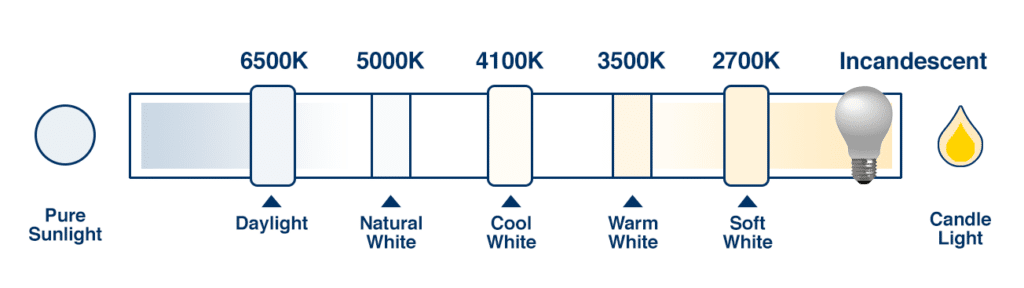
The color of light is measured on the Kelvin calibration, which is really a mensurate of temperature. This is why light bulb manufacturers oft refer to "colour temperature" on the packaging. The numbers yous come across on the side of the packaging denote the colour of light that the bulb will emit. Most people accept go used to the warm yellowy low-cal given out by the old incandescent bulb, which is 2,700 on the Kelvin calibration. In comparison, midday sunlight is virtually 5,000k, dusk or sunrise lighting is around ii,500k, and a candle is around i,600k.
The colour of light can impact everything from your mood to the colour of the vegetables on your chopping board, so it's of import to get the color of light that you prefer. Use the reference beneath to friction match the Kelvin scale rating with the colour you lot're after.
To complicate matters further, each bulb is given a CRI score. CRI stands for Colour Rendering Alphabetize, and is a measure out of the ability of the light source to accurately stand for dissimilar colours. Simply put, yous want to brand certain you get a bulb that makes your tomatoes look red, rather than a strange orangey colour.
Traditional incandescent and halogen bulbs are about perfect and score in the high 90s. LEDs and CFLs are a little backside this and are more probable to have a CRI value in the mid 80s. 80 is considered an acceptable level, although similar many things this comes down to personal preference.
4. Find the best shape
Now that you know what plumbing fixtures, colour, and brightness y'all crave, yous need to make up one's mind what shape of bulb you lot'd like.
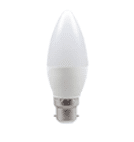
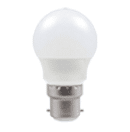
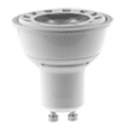
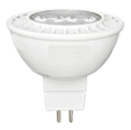
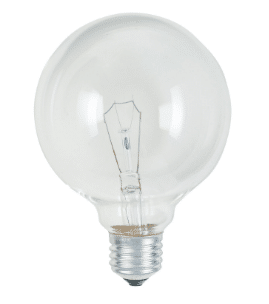
If you lot are replacing a blown seedling, you can but replace like for like. If you take a new fixture or are upgrading to LEDs, which are available in many different shapes, you may need to select a different bulb shape. Each of the different shapes provides a slightly unlike spread and angle of light, from the almost 360 degree spread of a GLS, globe, or golf bulb, to the narrow axle of a spotlight. Generally speaking, the shape you lot choose can be based on your personal preference and what looks all-time in your fixture.
Here is a brief breakdown of the most common bulb shapes:
Candle | GLS/Standard | ||
|---|---|---|---|
 | Features & Uses
| 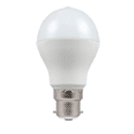 | Features & Uses
|
Golfball | GU10/PAR16 | ||
 | Features & Uses
|  | Features & Uses
|
Reflector | Capsule | ||
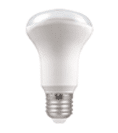 | Features & Uses
| 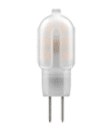 | Features & Uses
|
Striplight | Tube | ||
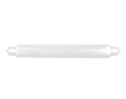 | Features & Uses
| 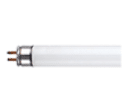 | Features & Uses
|
Dichroic | Globe | ||
 | Features & Uses
|  | Features & Uses
|
The "correct" shape of the bulb and spread of the low-cal depends on your personal preference, but remember to consider how the bulbs volition expect when they are switched off as well as on. Likewise, consider whether they will fit logically in their called fitting – you don't desire a large stick shaped bulb if information technology will protrude from the top of your bedside lamp!
5. Try Our Seedling Finder
Armed with all the information you lot need and having made the key decisions as to what type of bulb you crave, you may observe our Bulb Finder tool helpful in locating the choice of bulbs to match.
Should you lot need any more technical or additional information about the light bulbs y'all are looking for and so delight contact our friendly, knowledgeable Client Service team on 01869 362222.
Source: https://www.thelightbulb.co.uk/resources/how-to-find-the-right-light-bulb-step-by-step-guide/
0 Response to "How Do You Know if a Light Bulb Is Halogen"
Post a Comment